Introduction
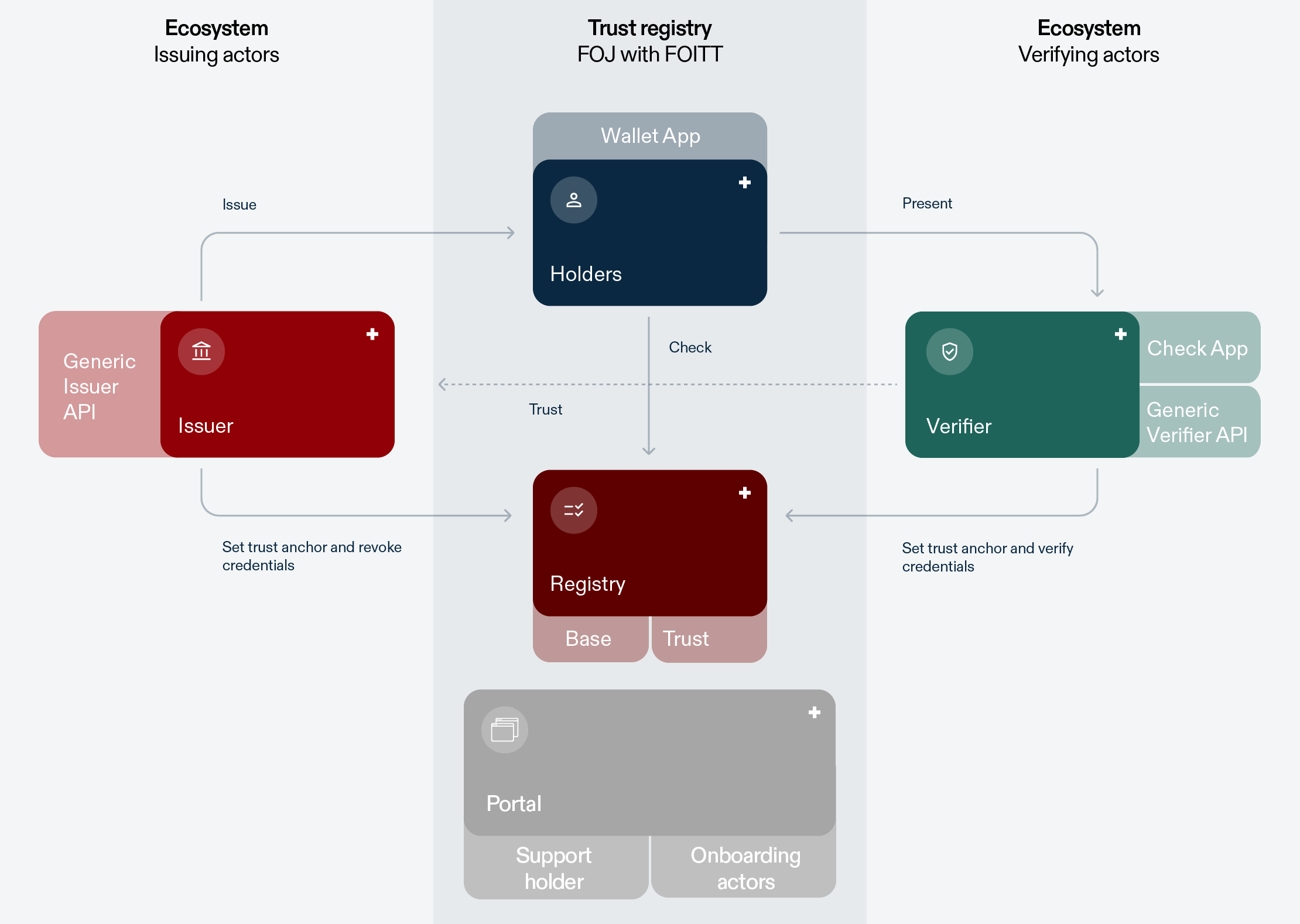
The swiyu Trust Infrastructure builds the backbone for the implementation of the BGEID (Bundesgesetz über den elektronischen Identitätsnachweis und andere elektronische Nachweise). Its main purpose is to lay a technical foundation that enables secure and trusted digital interactions between issuers, holders and verifiers of digital credentials, while giving users the control over which information they share with whom. User control is achieved by providing holders with digital credentials that can be managed through the swiyu wallet developed by the Swiss Confederation as well as third party wallets. Data integrity and authenticity build the foundation of security and trusted interactions. This trust is established on a cryptographic and organizational level and implemented through the swiyu Base and Trust Registry. The following outlines the core elements of the BEGID ecosystem and the swiyu Trust Infrastructure.
Roles
Holder & Wallets
Holders are at the centre of the ecosystem. They receive credentials from an issuer and can present these to a verifier whenever they want. When presenting a credential, holders generate a cryptographic proof that ensures presentations are time-bound and cannot be maliciously forwarded by the verifier or another entity. Holders can manage their credentials and generate cryptographic proofs with the help of a wallet application (hereafter referred to as “wallet”).
The wallet can best be described as a secure, digital application (e.g., installed on a mobile device) that stores and manages digital credentials issued to individuals. This wallet is the primary interface through which individual holders (e.g. citizens and residents) interact with other participants.
The wallet securely holds digital credentials, such as the e-ID credential. It also provides information about the status of credentials (e.g., whether the credential is valid or had been revoked) and will allow holders to view their personal usage history of the wallet. In interactions with verifiers, it provides holders control over their data disclosure, by letting them decide which credentials or content thereof to share. Using techniques for user authentication and device binding, the wallet ensures that only the user can access and share the stored credentials.
In essence, the wallet is a crucial element in the swiyu Trust Infrastructure, as it enables user autonomy and decentralization. By design, credentials are stored in a decentral manner solely on a user’s device, reducing risks of mass data breaches and preventing tracking of usage by a centralised body. The Confederation provides users with a wallet (swiyu) which allows them to request, hold and present credentials in an easy and privacy preserving manner.
Issuer
Issuers are entities responsible for creating and issuing digital credentials to the wallets of holders. These credentials are designed to certify specific information about or otherwise associated with the holder, such as their identity, data relating to their person, qualifications or simply event tickets.
The Issuer independently decides, what information is contained in a credential. To certify this information the issuer cryptographically signs the credential, ensuring that it is tamper proof and remains verifiable. Issuers are responsible for the lifecycle management of credentials they provide. Hence, they take care of revoking, suspending, or re-issuing credentials, when necessary. Thus, they ensure the integrity and reliability of issued credentials.
Every entity from the private or public sector could be an issuer using the swiyu Trust Infrastructure if they fulfil the technical and the general requirements for the onboarding. They can then issue credentials to a wallet. During the issuing process, they may further prove that they are a verified identity and/or legitimate issuer if they are registered as such in the Trust Registry (see below).
Verifier
Verifiers are entities that validate the credentials presented by holders to prove specific information. Verifiers confirm the integrity, authenticity and validity of credentials by checking the cryptographic signatures associated with the proof, both from the issuers and the holder wallet. They can also check the status of credentials to evaluate whether the presented credentials are still acceptable.
Another primary role of verifiers is to interpret the content of the credentials. The required content and interpretations to achieve this is defined by the context and services of a verifier and the user data that is necessary to provide the service or to fulfil the specific context.
Registries
The registry is the entity that provides information about the identity of issuers and verifiers and data to verify the validity of credentials. The aforementioned information is publicly available. In the swyiu Trust Infrastructure two different registries are provided by the Swiss Confederation: The Base Registry and the Trust Registry.
Base Registry
The Base Registry serves as a publicly available registry of technical identifiers that represent entities using the infrastructure as issuers or verifiers. This can for example be legal entities, government agencies, or individuals. It provides cryptographic methods to register, update and verify identifiers, in the form of decentralized identifiers (DIDs) possessed by these entities.
Every DID has cryptographic key material associated with it that is used to establish secure connections, sign credentials or verify that a credential originates from a registered issuer and was not altered after issuance. The key material is retrieved via the corresponding DID of the issuer or verifier that is registered on the Base Registry and resolves to a DID Document (also stored on the Base Registry). Hence, the Base Registry only contains DIDs together with the associated DID Documents and no information on whether a DID is used to represent an issuer or a verifier. In the case of the swiyu Trust Infrastructure, the Base Registry is operated centrally by the Swiss Confederation. Integrity of the data provided on the registry is assured by relying on publishing data signed at the source of creation.
In addition, the Base Registry enables issuers to maintain life-cycle information of verifiable credentials that states if a credential is valid or has been revoked or suspended. By doing this it supports secure and reliable verification of electronic credentials and provides information on their validity status in a privacy-preserving manner. The design ensures that any status information cannot reveal details about the respective credential’s holder or content.
In summary, the Base Registry provides means for secure and efficient verification and issuance which is essential for gaining and maintaining trust in the swiyu Trust Infrastructure. It is implemented by the Federal Office of Information Technology and Telecommunications (FOITT), containing only the data necessary for the legal purposes defined in Art. 2 BGEID.
Trust Registry
The Trust Registry provides trust through implementing human-readable measures to support decisions about whether users want to trust actors they interact with or the information they receive. This complements the cryptographic trust provided by the Base Registry.
To support trust, the Trust Registry confirms the mapping between an identifier (DID) that is registered on the Base Registry and the name of the entity as it is known in the physical world (for example, the name listed in the commercial register or stated in a passport). The connection between the DID and the entity it represents is validated by the FOJ. After successful validation, a signed trust statement is published on the trust registry and issued in the form of a verifiable credential containing the DID and the associated entity name.
The mechanisms of the base registry will be used to provide information about the status of the trust statements. Hence the status information will be stored separately to the trust statement itself, guaranteeing privacy during trust statement validation.
Components and Governance
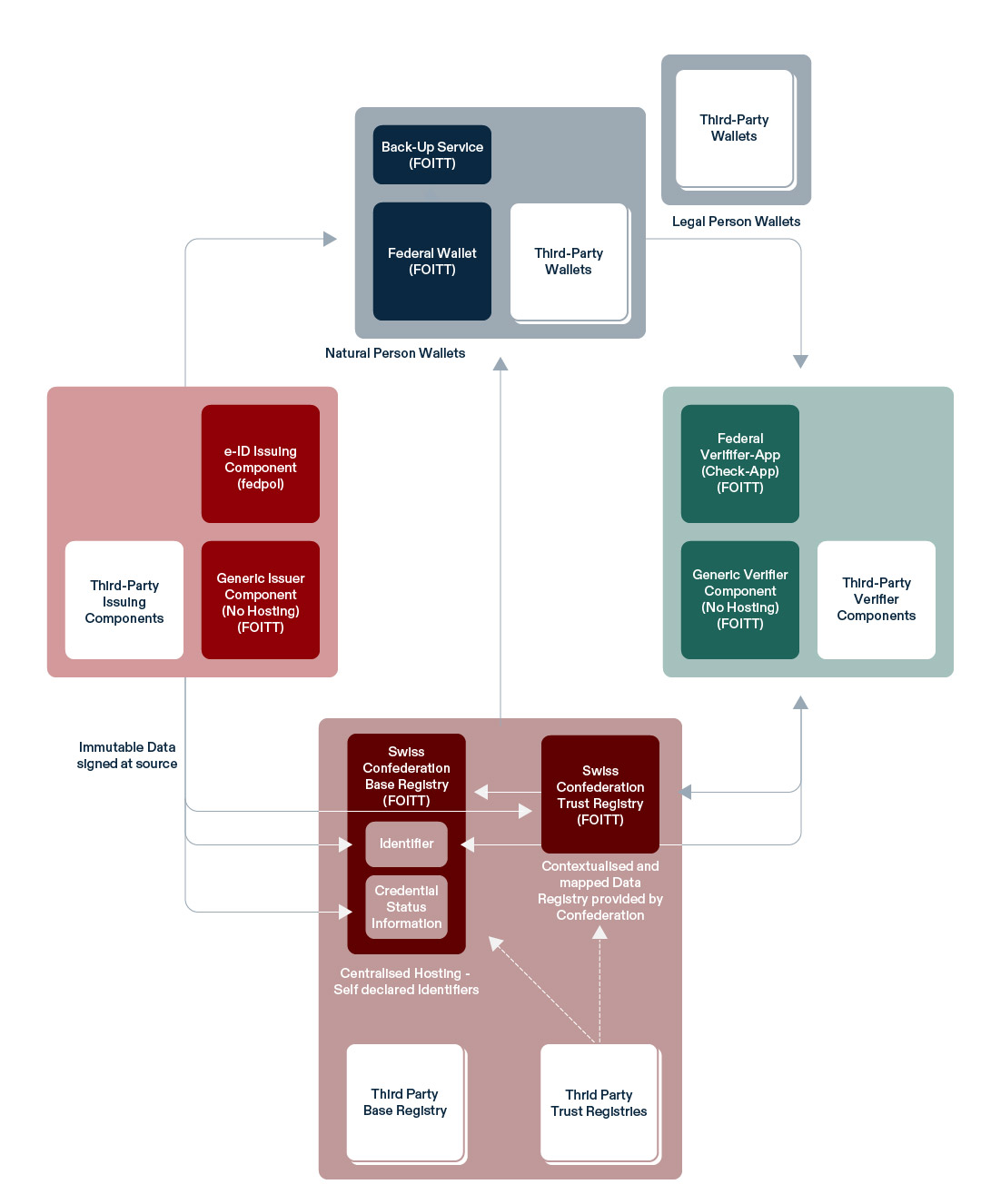
The Confederation is developing various components to support issuers, holders and verifiers in their management and exchange of the e-ID and other credentials. The following provides a vision of the future swiyu ecosystem and the Trust Infrastructure. It details the components that are or will be developed by the Confederation, where these are hosted, how these interlink with one another and how third-party components can interact with the swiyu Trust Infrastructure.
Role-specific components provided by the Confederation
swiyu
swiyu is the mobile wallet app provided by the Confederation. Swiyu allows users to securely receive and manage their e-ID and other digital credentials as well as share these with a verifier via the web or in-person. In addition, the wallet retrieves and displays trust information (from the swiyu Base and Trust Registry). The swiyu wallet is developed by the FOITT as an Open Source component. In the future, the Confederation might extend the wallet with a Backup Service allowing holders to store backups on a state-provided infrastructure.
e-ID Issuing Component
The e-ID issuing component is a specialized issuer system operated and used by fedpol. It is tailored to the specific infrastructure and processes required for issuing Swiss e-IDs. The e-ID issuing component can issue e-IDs into the swiyu wallet. As an issuer the fedpol uses the the swiyu Base and Trust registry to provide information on the DIDs used for issuing e-IDs and the e-ID’s validity status. Issuing Swiss e-IDs to third-party wallets will be possible in the future, given that these wallets fulfil defined requirements.
swiyu Generic Issuer
The swiyu Generic Issuer is a reference implementation that bundles core functionalities required for issuing and managing the lifecycle of digital credentials. It is provided Open Source by the FOITT but needs to be operated individually. Any issuer can make use of and tailor this reference implementation to specific needs for issuing digital credentials. By default, it will be interoperable with the swiyu wallet, the swiyu Base Registry and the swiyu Trust Registry. Interoperability with third-party components will be possible, if these are conformant to the specifications of the swiyu Trust Infrastructure and/or specifically integrated by the issuers themselves.
swiyu Check
The swiyu Check app is the official mobile verifier application that will be provided by the FOITT. The app can be used to verify Swiss e-IDs in a face-to-face situation. The app can be used for verifying credentials that are stored in the swiyu wallet as well as third-party wallets that are interoperable with the swiyu Trust Infrastructure. In the future, swiyu Check may also be able to verify credentials other than the e-ID.
swiyu Generic Verifier
The swiyu Generic Verifier is a reference implementation that bundles core functionalities required for verifying the e-ID and other digital credentials over the internet. Its components are provided Open Source by FOITT but need to be operated individually. Any verifier can integrate and adapt this reference implementation to their business needs. By default, it will be interoperable with the swiyu Trust Infrastructure (i.e., swiyu wallet, swiyu Base Registry and swiyu Trust Registry). Interoperability with third-party components may be possible, if these are conformant to the specifications of the swiyu Trust Infrastructure and/or specifically integrated by the issuers themselves.
swiyu Base Registry
The swiyu Base Registry is a public registry hosted by the FOITT. It holds identifiers and the respective public keys of issuers and verifiers, as well as the revocation status lists of the e-ID and other digital credentials. Any entity can on- and offboard from the registry as an issuer or verifier. For integration with other components, the source code of the swiyu Base Registry is openly available.
swiyu Trust Registry
The swiyu Trust Registry is a public registry hosted by FOITT. It holds trust statements that verify identifiers and provide a mapping to the real-world name of their subjects. The swiyu Trust Registry will only refer to identifiers that are published in the swiyu Base Registry. In addition, it can hold trust artefacts that certify legitimate issuers and verifiers for specific use cases. These trust artefacts are additionally issued in the form of a VC to their holders. The entries of identity trust statements are managed by the FOJ, who verifies the linkage between actor and identifier. The FOJ will also manage issuer and verifier trust statements for entities fulfilling regulated functions. In consequence, any entity aiming to be certified with a trust statement must publish their identifier in the swiyu Base Registry. For integration with other components, the source code of the swiyu Trust Registry is openly available .
DID Toolbox & Resolver
Besides these role-specific components, FOITT is also developing complementary tooling for managing DIDs that can be of help for multiple roles. The currently provided and supported general Open Source tooling covers a DID Toolbox and a DID resolver.
Third-party Components
The Swiss Confederation does not exclude the development of third-party components that interact with the swiyu Trust Infrastructure. In general, entities are free to develop proprietary and open-source components and distribute them in the Swiss market. While doing so, adhering to the specifications set by the Confederation is highly recommended to ensure full interoperability with the Trust Infrastructure.
For certain use cases and services, additional restrictions may apply. For instance, third-party registries may not automatically be integrated within the swiyu wallet, Check App, and other components. On the other hand, certain complementary services provided by the Confederation may only be accessible with the respective swiyu components, such as the swiyu Backup Service.
Credential Lifecycle
A credential lifecycle refers to the series of stages that a digital credential undergoes, from its initial definition all the way to its invalidation or replacement. It typically starts with defining the credential’s structure (schema), personalizing it for an individual holder, continued by issuing it and securely binding it to that holder. Once issued, the holder receives control over the credential and can freely handle its presentation. The lifecycle also includes the stages of suspension or revocation of a credential if it’s compromised or no longer valid. It allows for renewal of the credential to ensure continued accuracy and trustworthiness.
| Lifecycle Stage | Important Actions/States | Description |
|---|---|---|
| Pre-Issuance | Schema Definition | Defining the structure and attributes of a credential (e.g., name, age), to enable consistent issuance and verification. |
| Credential Design | Defining the user facing design elements that can enable improved recognition, relation and overall user experience. | |
| Issuance & Valid | Data Entry | Customizing the credential data by entering the (holder-specific) attribute information that are intended to be associated with that credential. |
| Issuance | Providing the credential to the holder wallet using secure protocols and cryptography to enable in-wallet storage after successful authentication of the holder. | |
| Device binding | Binding the credential cryptographically to the holder’s device during the issuing process. | |
| Presentation | Sharing information encoded in the credential with a verifying entity. | |
| Invalid | Expiration | Marks a credential whose validity has been expired (not preventing further use but signalling that it may no longer be trusted). |
| Revocation | Marks a credential as invalid or no longer trusted, not preventing further use, but signalling a noteworthy deviation from the expected state of the credential to the verifier. | |
| Suspension | Signals a temporary disablement (without full revocation) of a credential, with the option for reactivation (e.g., for cases like suspension). This is not preventing further use but signalling a state to the verifier. | |
| Renewal | Re-issuance (update) | Issuance of a new credential (with update of credential attributes). |
| Re-issuance (refresh) | Issuance of a new credential (without update of credential attributes). |
Trust in the swiyu ecosystem
The swiyu Trust Infrastructure supports the development of trust between interacting parties by different means. An important part of this are the trust artefacts. For a more in-depth technical documentation please refer to the specification of the latest Trust Protocol.
Overview
Trust Artefacts in swiyu
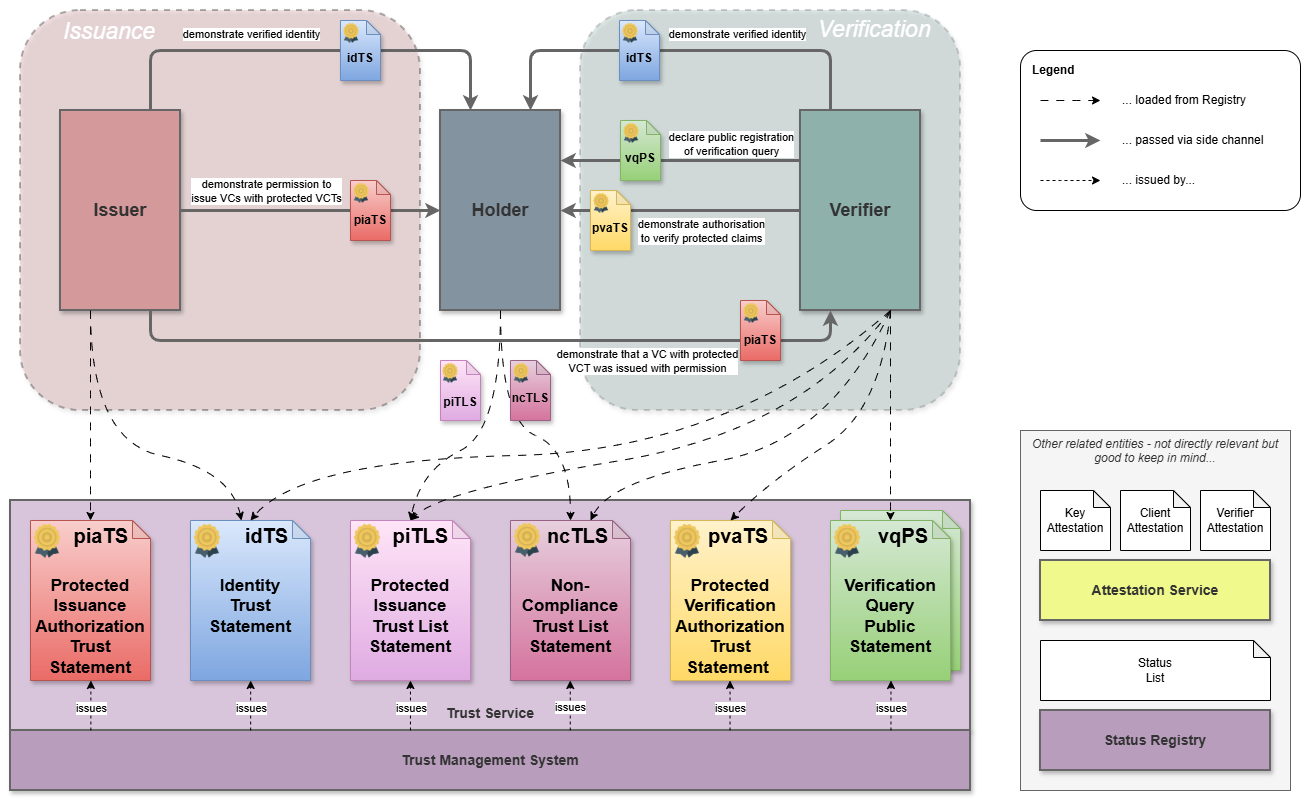
Trust in the swiyu ecosystem is built on trust artefacts. A trust artefact is a cryptographically signed statement (JWT) about an entity, asserting that specific information about a subject is valid and verifiable.
All trust statements are issued by the [Trust Management System], which is part of the Trust Registry and acts as the central trust authority in the swiyu ecosystem. These statements are made available via the Trust Service APIs, forming the second component of the Trust Registry.
The following types of statements exist:
- Trust Statements: Attest verified information about a subject. They are issued only after formal human review and approval.
- Public Statements: Attest that self-declared information about a subject has been recorded in a public register. The self-declared content is not reviewed.
- Trust List Statements: Provide exhaustive and self-contained information about the swiyu trust ecosystem. As a result, the absence of an entity from a list is semantically meaningful and can be interpreted accordingly (e.g. non-compliance list).
Trust Statements
Identity Trust Statements (idTS)
| Purpose | Expresses trust in the identity of the trust subject. The subjects can hereby prove that their identity was verified by the Federal Office of Justice. |  |
|---|---|---|
| Details | Trust Protocol 2.0: Identity Trust Statements (idTS) | |
| Provisioning | Available via API from | Trust Registry |
| Side channel | Verification: verifier_info in JWT-Secured Authorization Request Issuance: tbd |
|
Protected Verification Authorization Trust Statement (pvaTS)
| Purpose | Expresses that a verifier is allowed to verify certain protected claims. Example: verification of the SVN ("AHV Nummer"). |
 |
|---|---|---|
| Details | Trust Protocol 2.0: Protected Verification Authorization Trust Statement (pvaTS) | |
| Provisioning | Available via API from | Trust Registry |
| Side channel | Verification: verifier_info in JWT-Secured Authorization Request | |
Protected Issuance Authorization Trust Statement (piaTS)
| Purpose | Expresses that a given issuer is allowed to issue VCs of a certain protected VCTs. Example: only Fedpol is allowed to issue e-ID |  |
|---|---|---|
| Details | Trust Protocol 2.0: Protected Issuance Authorization Trust Statement (piaTS) | |
| Provisioning | Available via API from | Trust Registry |
| Side channel | Issuance: via Issuer Metadata Verification: via Trust Registry |
|
Public Statements
Verification Query Public Statement (vqPS)
| Purpose | Expresses that the verification query used by a verifier was registered in the Trust Registry for public record. Note that there is no verification of the content, only that there was a registration of it. |  |
|---|---|---|
| Details | Trust Protocol 2.0: Verification Query Public Statement (vqPS) | |
| Provisioning | Available via API from | Trust Registry |
| Side channel | Verification: verifier_info in JWT-Secured Authorization Request | |
Trust List Statements
Protected Issuance Trust List Statement (piTLS)
| Purpose | Contains an exhaustive list of all VC types whose issuance is protected. Absence from the list means the VCT is not protected. |  |
|---|---|---|
| Details | Trust Protocol 2.0: Protected Issuance Trust List Statement (piTLS) | |
| Provisioning | Available via API from | Trust Registry |
| Side channel | - | |
Non-Compliance Trust List Statement (ncTLS)
| Purpose | Contains an exhaustive list of all actors which were declared as in violation of compliance by FOJ. Absence from the list means an actor is compliant. |  |
|---|---|---|
| Details | Trust Protocol 2.0: Non-Compliance Trust List Statement (ncTLS) | |
| Provisioning | Available via API from | Trust Registry |
| Side channel | - | |